
An Incomplete Haunting
Curated by Rachel Raphaela Gugelberger601Artspace, 88 Eldridge Street, NYC
Nov 22, 2025 - Feb 22, 2026
View installation images here
Hyperallergic review: We Are History’s Ghosts by Lisa Yin Zhang
Elvira Clayton
Nona Faustine
Yevgeniy Fiks
Nicholas Galanin
Chitra Ganesh + Mariam Ghani
Ken Gonzales-Day
Kris Grey
Alicia Grullon
Miguel Luciano
Angel Nevarez & Valerie Tevere
Andrea Ray
Dread Scott
Kenneth Tam
Mark Tribe
Curator’s Statement:
(download the essay as a PDF)
“If history is to be creative, to anticipate a possible future without denying the past, it should, I believe, emphasize new possibilities by disclosing those hidden episodes of the past, when, even if in brief flashes, people showed their ability to resist, to join together, occasionally to win. I am supposing, or perhaps only hoping, that our future may be found in the past’s fugitive moments of compassion rather than in its solid centuries of warfare.” —Howard Zinn, A People’s History of the United States 1492—Present
“Lately I have been thinking about the idea of a shadow book—a book that we don’t have, but know of, a book that may haunt the very book we have in our hands.” —Kevin Young, The Grey Album: On the Blackness of Blackness
An Incomplete Haunting gathers research-driven and place-based works across photography, video, sculpture, installation, sound, reenactment documentation, and ephemera. Together, these projects demonstrate how art can confront and illuminate the past, making visible stories that official narratives have long obscured. In an era of historical denialism, censorship, book bans, and the criminalization of dissent, the exhibition foregrounds narrative craft as a tool for preserving polyvocal memory and resisting institutional erasure.
The exhibition’s title draws inspiration from Howard Zinn’s A People’s History of the United States and Kevin Young’s The Grey Album: On the Blackness of Blackness, especially Young’s notion of “shadow books”—histories that haunt the ones we hold. In this spirit, An Incomplete Haunting uses contemporary art and exhibition-making to highlight the vital role that creative practice plays in (re)shaping historical interpretation and memory.
Nicholas Galanin’s Never Forget (2021) confronts the legacy of colonial violence and the systemic erasure of Indigenous presence with his monumental installation at the 2021 Desert X biennial, spelling “INDIAN LAND” in 45-foot-tall white block letters. Represented in this exhibition by a documentary photograph, the sculpture evokes the iconic Hollywood sign, originally erected in the 1920s as “HOLLYWOODLAND” to promote a whites-only housing development. The word “LAND” was later removed in 1949 to sanitize the image for popular culture. By highlighting the ongoing Land Back movement, Galanin emphasizes that recognition without restitution is incomplete and that historical awareness carries the ethical responsibility to take action.
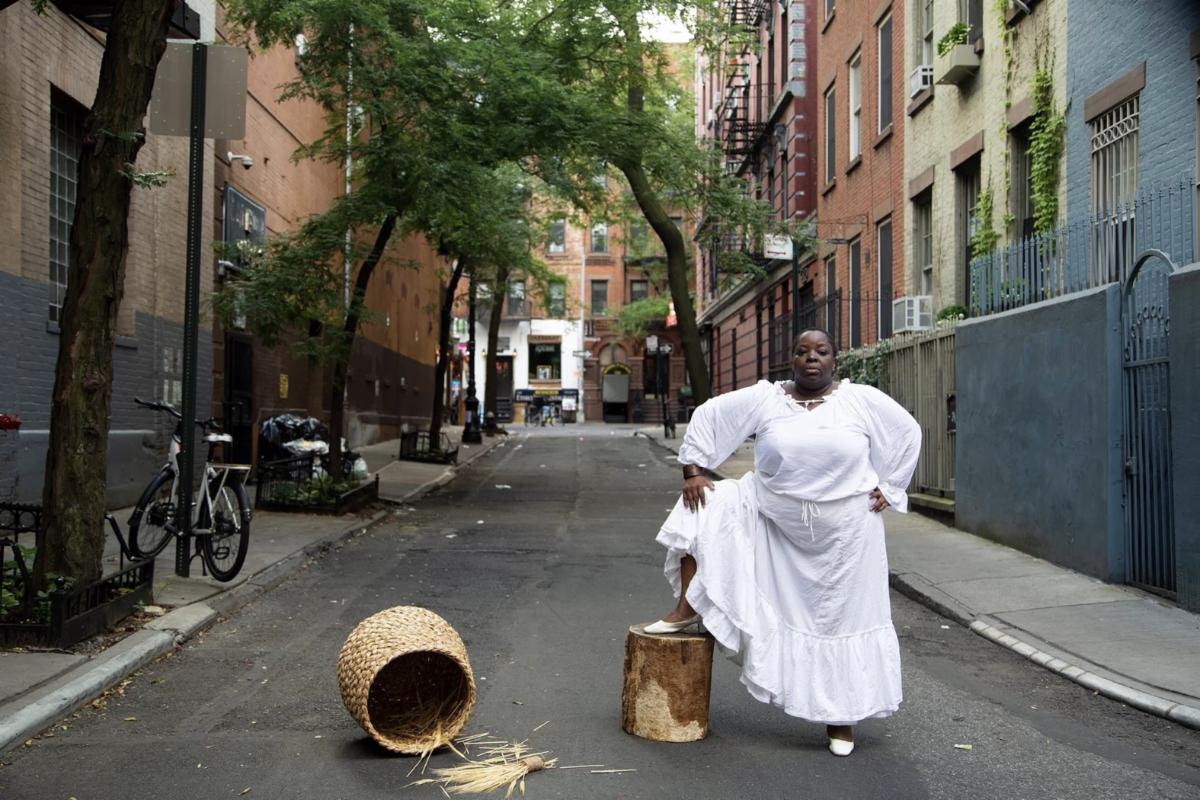
In Nona Faustine’s (1977–2025) photographic series White Shoes, the artist embeds her body—and, by extension, her ancestry—in sites deeply tied to New York City’s history of slavery. In Dorothy Angola Stay Free, In Land of the Blacks (2021), Faustine appears in all white, planting her right, white kitten-heeled foot atop a tree stump on Minetta Lane in Greenwich Village. Dorothy Angola was among the first enslaved women trafficked to New York by the Dutch West India Company between 1626 and 1640. She successfully fought to inherit her late husband’s property in the “Land of the Blacks.” Named after the Minetta Brook that once flowed through the area, Minetta Lane and its neighboring Washington Square Park once formed part of one of North America’s first semi-free Black settlements, which was previously used as a buffer between Dutch and Indigenous communities. Today, NYU occupies a significant portion of this land. And while it acknowledges the Lenape as the area’s original inhabitants, the university commemorates neither Angola nor the Black landowners who inhabited the land during a long interim period. Faustine’s corporeal presence commemorates these lives, transforming public spaces into sites of remembrance and reclamation.
Re-presenting the past to bring it into dialogue with the present, Dread Scott’s community performance, Slave Rebellion Reenactment (2019), restaged the 1811 German Coast Uprising, the largest rebellion of enslaved people in U.S. history. Unlike historical revivals that romanticize the past, Scott’s project interrogates political power, slavery as an economic system, and the pursuit of freedom. Conceived and organized by Scott and documented by filmmaker John Akomfrah, the performance featured reenactors in period costume bearing flags symbolic of independence and historical weapons, as they marched through contemporary Orleans Parish—a landscape now transformed by oil refineries and climate change. On display in the exhibition are performance stills and Army of the Enslaved Flag (Ogun), 2019. Depicting a machete, the image holds dual significance: it represents the violence of agricultural, enslaved labor, and serves as a tool of self-defense and rebellion. The machete is also a symbol of the Yoruba Orisha (deity) Ogun, who is revered as a protector and enforcer of justice. This symbol confronts the enduring links between chattel slavery and extractive industries, systems of exploitation that continue to generate wealth through dispossession and persist in new forms of environmental and social violence.
Elvira Clayton’s Indigo Bess and her Children, 436 Project (2024), consists of suspended fabric sculptures representing a mother and her children—Sam, Elizabeth, Sena, Affa, and Hannah—who had been sold at the largest slave auction in American history in Savannah, Georgia, in 1859. This auction was also known as the “Weeping Time,” though not for the trauma caused by the forced separation of families, but rather for the torrential rain that fell over the two-day auction. Clayton’s sculptures conjure vanished bodies, created from materials that trace to the African diaspora, auction archives, indigo-dyed textiles, and Osnaburg fabric—a coarse, inexpensive fabric primarily used to clothe enslaved people—to amplify the memory of materiality, the specificity of each individual, and the brutality of slavery.
Works by Ken Gonzales-Day confront the history of lynching in the American West. Through meticulous archival research, he has documented over 350 lynchings in California between 1850 and 1935, highlighting the historic absence of Latinx, Asian, and Native American victims in the recorded history of lynching. These crimes have historically been less visible than the more widespread mob violence against Black Americans in the American South.
In his Erased Lynching series begun in 2002, Gonzales-Day digitally removes victims and ropes from historical lynching photographs, leaving only the surrounding crowds and landscapes. This shifts focus from the spectacle of death to the collective performance of racialized power—the mob itself becomes the subject. Created to circulate as souvenir postcards, the original images reveal how violence was normalized as both a ritual and a public assertion of white supremacy in the American West. In the related series Searching for California’s Hang Trees, Gonzales-Day turns to the trees themselves as silent witnesses. Golden Chain (2005) depicts a massive Laburnum tree against a bright blue sky, transforming the tree, which was used as a gallows, into a memorial of endurance that demands acknowledgment of the racial terror that continues to shape the present day.
Kenneth Tam’s sculpture Why do you abuse me (2022) illuminates the lives of Chinese laborers on the Transcontinental Railroad. Incorporating soil from Texas rail sites, dried fruits, and seeds, the work evokes nourishment, ritual talismans, and traditional Chinese cooking and medicine. Referencing a 19th-century English-language phrasebook distributed to Chinese workers, Tam underscores the xenophobia, danger, and resilience that shaped their daily lives. By linking material traces to historical research, the sculpture renders visible unrecorded labor and humanity, extending memory into the natural world. Just as the trees bear witness in Day’s photographs, so too does the soil in Tam’s sculpture hold memory.
Works by Yevgeniy Fiks examine the intertwined Red and Lavender Scares, products of Soviet-American paranoia and U.S. anti-gay rhetoric. Featured in the exhibition is a selection of works from the series Homosexuality is Stalin’s Atom Bomb to Destroy America (2012), titled after a 1953 article by Cold War commentator Arthur Guy Mathews, who framed homosexuality as a national threat. Photographs of a six-foot photo prop representing the 1949 Soviet nuclear test RDS-1 standing in former gay cruising locations in Washington, DC, are presented alongside archival anti-Communist and anti-gay quotations, revealing how fear and state power manipulate collective memory.
Kris Grey’s Capital T (2025) is a ready-made piece of structural joists salvaged from the original dance floor of the Stonewall Inn, site of the 1969 Stonewall Uprising. One of the few gay bars in the Village where patrons could dance freely, the Stonewall Inn stands as a revered National Historic Landmark, a birthplace of resistance that ignited a global movement for LGBTQ+ rights. Capital T confronts a recent act of erasure by our current administration—the removal of the “T” and “Q” from the Stonewall Inn’s plaque. This omission seeks to exclude transgender and queer people from their own history. Capital T defies this erasure by monumentalizing queer and trans presence, reclaiming space in both physical and symbolic terms.
Mark Tribe’s Port Huron Project (2006–2008) documents the reenactment of protest speeches from New Left movements of the Vietnam Era, linking past calls for justice to ongoing struggles over genocide, war crimes, political dissent, economic inequality, and institutional racism. Collectively named after the 1962 manifesto by the Students of a Democratic Society, each reenactment was performed at its original site by actors or performance artists for an audience of guests and passersby. The series includes speeches by Stokely Carmichael, Angela Davis, Howard Zinn, and Cesar Chavez, activists whose messages continue to resonate today.
In 1969, the Puerto Rican youth activist group Young Lords established a New York chapter in East Harlem, where their social justice organizing became a vital force in the neighborhood. In 2019, on the movement’s 50th anniversary and amid the rapid gentrification of the neighborhood, Miguel Luciano revisited the Young Lords’ legacy through the public art project Mapping Resistance: The Young Lords in El Barrio. The project brought the group’s history to life through public programs, storytelling walks, and large-scale archival reproductions of photographs by Hiram Maristany (1945-2022)—an original Young Lords member, their official photographer, and a lifelong community resident—installed at key sites. Included in An Incomplete Haunting is a banner depicting a Young Lords member holding up the June 5, 1970, issue of Palante, the bilingual newspaper published by the Young Lords Party. On that date, the group occupied Lincoln Hospital in the South Bronx to protest inadequate and unsafe healthcare for Puerto Rican and Black communities.
Also on view is Luciano’s Shekere pa’ Santa Bárbara (2025), which transforms a 17th-century iron cannonball from Puerto Rico’s Spanish colonial past into a shekere—a West African percussion instrument beaded in the colors of Santa Bárbara, the patron saint of artillerymen and those who work with explosives. Santa Bárbara also represents Changó, the Yoruba Orisha associated with thunder and lightning, war and justice, as well as percussion, rhythm, and dance. Though unplayable, the work resonates with the imagined sound of music, turning an object of violence into one of transcendence. Shekere pa’ Santa Bárbara envisions the liberatory possibility of rhythm and celebration, reverberating beyond the weight of colonial history and across Puerto Rico’s layered spiritual and cultural heritage. In its form and texture, the shekere evokes histories of Spanish colonization, the near-eradication of the Indigenous Taíno, African enslavement, and the syncretic cultures and religions that emerged from these intertwined legacies.
Angel Nevarez & Valerie Tevere’s practice spans geographies and time, exploring music—and sometimes silence—as a form of enduring dissent. Combining time-based media with songwriting, voice, and civic participation, Layers of the City (2019) reflects on the displacement of generations of immigrant-owned spaces in Santa Ana, California, driven out of the area by rising rents, redevelopment, and speculative real estate. Against a backdrop of local shuttered businesses and vacant storefronts, the artists convened an intergenerational group of community members to sing in both Spanish and English; videos of these performances are presented in this exhibition. Each community-composed verse builds upon the last, metaphorically reenacting the transformation of place: as new voices and inhabitants are added, the community’s shape—and memory—shifts and contracts. Layers of the City reflects on displacement and the erosion of diversity, emerging as both a record of transformation and a chorus of voices insisting on their place in history.
“How can gender equality be achieved when our local, state, and governmental representatives do not represent our intersectional selves?” asks artist Andrea Ray. The Sound of Women’s Rights (2020-2025) emanates from a tall, standing ceramic trumpet, its interior shaped with abstracted biological details of an inner ear. The work layers audio from archival women’s marches in 1970; self-recorded audio from 2017 protests; recordings of women performing suffrage slogans (wearing Covid-era masks) in Ray’s hometown of Utica, New York; and other archival and online sources. By bridging the 1970s campaigns for the Equal Rights Amendment with the global Women’s Marches of 2017—spurred by the first Trump administration’s restrictions on reproductive healthcare—Ray creates an audible historical continuum, tracing political slogans and demands that span over 175 years of the U.S. women’s rights movement.
Alicia Grullon’s video works combine fictional reenactment and role-playing to capture collective solidarity during recent social crises: the near-total ban on abortion in Texas in 2023; George Floyd’s murder in 2020 by a Minneapolis police officer; the exploitation and health inequalities of “essential workers” during the COVID-19 pandemic; and the 2018 death of Jakelin Caal Maquin, a four-year-old Guatemalan girl who died of the flu at a U.S. migrant detention center. Each of Grullon’s videos engages both emotion and intellect, demonstrating how creative practice can shape the moral and political labor of remembering.
Since 2004, Chitra Ganesh and Mariam Ghani have collaborated on Index of the Disappeared, an ongoing project that serves as both an archive and a platform for public dialogue. Documenting disappearances, detentions, and censorship in the wake of 9/11, the project illuminates how U.S. policies of secrecy and surveillance have shaped the lives of immigrant, “other,” and dissenting communities. Drawing on official documents, personal narratives, and secondary research, the artists trace hidden connections between state power and individual experience, revealing how secrecy sustains systems of injustice. Featured in the exhibition, Introduction to an Index (2011) is a constellation of redacted documents, handwritten notes, and archival materials that point to the absences, omissions, and silences within regimes of secrecy. The work prompts viewers to consider how institutions such as the Department of Homeland Security and Immigration and Customs Enforcement, established in the aftermath of 9/11, have entrenched systems of surveillance and control, and how official records obscure the actual impact of these systems on individuals and their communities today.
The works on view in An Incomplete Haunting emerge less as surrogates for history than as instruments for confronting its gaps and biases, revealing the past as contested, alive, and unresolved. Linking lived experiences across time and space, they undertake the slow labor of drafting a historical correction—showing that remembering is fraught, historical erasure is systemic, and history repeats itself, yet that facing the past honestly and inclusively is essential to justice and to the work of repair.
Curator’s Bio
Rachel Raphaela Gugelberger is a New York City–based curator whose work centers on place-based practices. She is currently the Curator of Visual Arts at Wave Hill, where she organizes the Sunroom Project Space. Exhibitions include Trees, We Breathe and Perfect Trouble: Queering Natureculture at Wave Hill; in pieces at PS122 Gallery; Bound up Together at Smack Mellon; Jameco Exchange in a vacant storefront in Southeast Queens; and Hold These Truths at the Nathan Cummings Foundation. Before joining Wave Hill, Gugelberger served as a guest curator for Residency Unlimited’s New York City–based artist residency program, which supports artists underrepresented in the arts. Previously, she was Associate Curator at No Longer Empty (NLE), a nonprofit organization that produced site- and community-responsive exhibitions and programs in distinctive locations such as vacant storefronts and landmark buildings. At NLE, she also directed the NLE Curatorial Lab program. Gugelberger holds an MA in Curatorial Studies in Contemporary Art and Culture from Bard College, New York.
Image: Nona Faustine, Dorothy Angola Stay Free, In Land Of the Blacks, Minetta Lane, the Village, NYC, 2021. © 2025 The Estate of Nona Faustine, courtesy The Estate of Nona Faustine and Higher Pictures.
![]()
601Artspace is proud to participate in #FallOfFreedom, a nationwide cultural movement uniting artists, institutions, and communities in celebration of creative expression and solidarity.
Follow @falloffreedom to learn more.

88 Eldridge St. New York, NY 10002
Tel: 212-243-2735
Open Thurs-Sun 1-6pm
© 601Artspace, 2018